
“I’m not heroic in any way.”
Project Hail Mary, adapted from the novel by Andy Weir (The Martian), follows Ryland Grace (Ryan Gosling, The Fall Guy), who wakes up from an induced coma alone on a spaceship, with no memory of who he is or how he got there. As he works to figure out his mission and regain his memories, he makes an unexpected discovery that will change the course of history in the shape of Rocky (James Ortiz, The Woodsman), an alien life-form whose own mission mirrors that of Ryland Grace.
I came into Project Hail Mary knowing only three things; it was adapted from a novel by the author of The Martian, it stars Ryan Gosling, and it has an alien rock creature. I didn’t really need to know any more than that to get me into the cinema, but I did wonder what the hook or the twist was going to be, given that Rocky’s existence was given away in the trailer. That was a little short-sighted of me, because having seen it, I now understand that the most important thing for this film was simply to get people into the cinema to see it at all, and that the story would do the rest of the work.
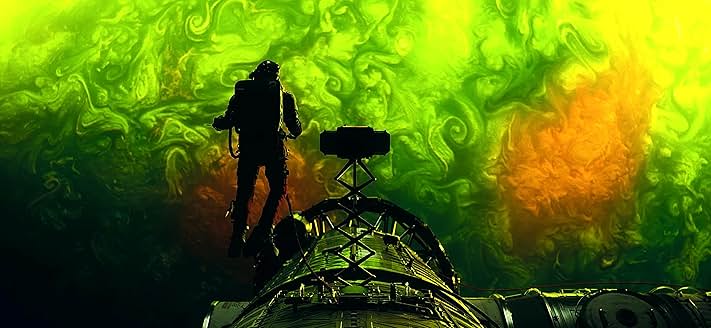
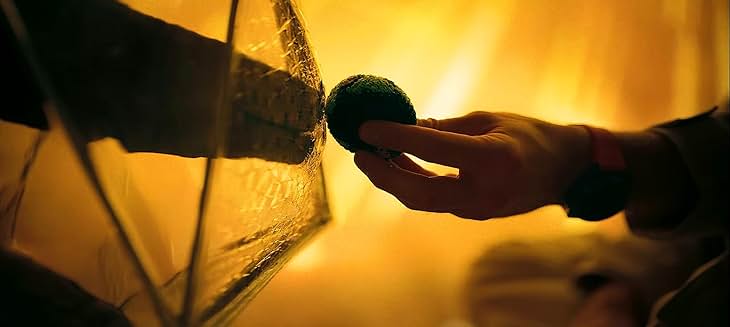
The sun is dying, as is every other star within reasonable study distance, and humanity’s best minds can’t figure out why; but they know that one star hasn’t been affected and a huge multinational effort to find out why is underway. Grace’s experience as a molecular biologist proves to be essential to the effort, and lands him on board the spaceship headed to Tau Ceti to investigate why it hasn’t been affected. He wakes up alone, with no other crew to help him, and as he is trying to figure out what he has to do and how he’s going to do it; a huge alien spaceship pulls up alongside and attempts to make contact, resulting in Grace meeting Rocky; a sentient, alien rock that seems to be half Muppet, half Pokemon, and becomes an essential partner for Grace’s effort.
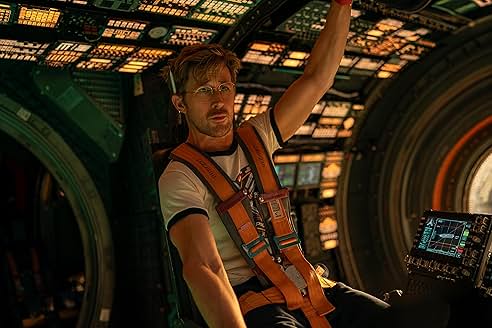
Project Hail Mary is very much an opportunity for Ryan Gosling to show off his skills; as for the majority of the film, aside from flashbacks to mission preparation, he is alone other than Rocky. This is not so dissimilar from Matt Damon’s position in The Martian, and sci-fi fans coming to Project Hail Mary as a result of their enjoyment of that film are not going to be disappointed. Gosling’s ineffable charm is on full display, but he also pounces on the chance to show his full range and does it very well, deftly maneuvering between comedy, tragedy, action and more; all while primarily acting to himself or to a puppet of a rock. That rock puppet is very important though, as Rocky provides an excellent foil for Grace, with Gosling and Ortiz deftly trading the roles of straight man and wise guy as the scenes require. I learned after watching that Ortiz and Gosling had developed so much chemistry together while Ortiz was puppeteering that he secured himself the role of Rocky’s actual voice during filming, which is a testament to the personality he developed within the character opposite Gosling, and I sincerely struggle to imagine any other voice within that role.

There are supporting human roles through the flashback sequences, the stand-out being Sandra Hüller (Anatomy Of A Fall) as Eva Stratt, the person in charge of the research mission. Hüller and Gosling also have excellent chemistry, with her straight-laced, no nonsense personality occasionally giving way to some softness as Stratt and Grace grow closer during the research effort. Lionel Boyce (The Bear) also makes his presence felt as Carl, a security agent assigned to Grace during his research on Earth. It’s a small role but he makes the most of it, and his natural charisma and comedic timing play well in the screen time he’s given.
Given that it’s a modern science fiction film set in space, Project Hail Mary relies on CGI for its outer space scenes, and does so very well; however, I was astonished to learn that directors Phil Lord and Christopher Miller (Spider-Man: Into The Spiderverse) made heavy use of practical effects for this film, including constructing a full set of the inside of the Hail Mary for Gosling to maneuver around. I had guessed that some of the sets were physical but hadn’t realised they built the whole ship, and this dedication to creating such a detailed, practical environment clearly elevated the production. Similarly, Rocky was brought to life through a combination of the previously-mentioned puppeteering, animatronics and digital enhancements; having a clearly-defined physical presence clearly helped with Gosling’s performance and brings a vital realism to Rocky’s presence on screen. Lord and Miller’s dedication to utilising practical effects is a demonstration of their range as directors, given their previous career high-point is an Academy Award for a purely animated film in Spider-Man: Into The Spiderverse.
All of this is to say that Project Hail Mary is an exceptional piece of cinema. Andy Weir’s novel translates brilliantly to screen. Lord and Miller’s dedication to a believable, tactile environment for Gosling to work in, alongside the work of Ortiz and the puppetry team on Rocky, come together for one of the most enjoyable cinematic experiences I’ve had in a long time. There’s one element of Project Hail Mary that I haven’t really touched on, however, and I think it’s the vein that runs through the whole piece and brings it all together; and that is hope. This film is unashamedly about hope; about navigating the unknown, about searching for the truth, and about doing the right thing. It’s a refreshing theme for modern science fiction, and feeling the hope running through the narrative is a refreshing lift.
At the time of publication, there’s still time to watch Project Hail Mary on the biggest screen you can find with the biggest bucket of popcorn you can buy, and I heartily recommend that you do that. You’ll regret it if you watch this one for the first time on an airplane.
 Dave Writes Reviews