
“You sold your soul to the devil when you put on your first pair of Jimmy Choos, I saw it.”
The Devil Wears Prada follows Andy Sachs (Anne Hathaway, The Princess Diaries), a budding journalist in New York City who lands a job as the second assistant to Miranda Priestly (Meryl Streep, Death Becomes Her), the legendary editor in chief of fashion magazine Runway, in a bid to gain experience and land a better position as a journalist. I didn’t watch The Devil Wears Prada when it first hit cinemas 20 years ago because I was a silly 18 year old who didn’t think that a film about a fashion magazine would have anything for me. I was a fool, because having watched it now, I understand that I missed out on a whip-smart and viciously funny pseudo fish-out-of-water story about a young woman doing her best to succeed in an environment that she’s under-prepared for.
Even after two decades, a lot of the central themes of The Devil Wears Prada remain pertinent. Andy enters a nightmarish work environment with an impossible to please boss and a downright rude immediate superior (in the shape of Emily Blunt as the incomparable and conveniently named Emily) in an attempt to better her on-going work situation, and which young person today wouldn’t relate to that? Andy Sachs was one of the roles that elevated Anne Hathaway to the Hollywood superstar level; demonstrating a maturity in her performance ability following the likes of The Princess Diaries and Ella Enchanted. She brings intelligence and wit to the role, and Andy’s evolution from naive young wannabe journalist to a more fashionable powerhouse is a joy to watch. Her attempts to juggle her career aspirations against her personal life are something that many of us could also relate to today, though her relationship with chef boyfriend Nate (Adrian Grenier, Entourage) is a surprising misfire amongst what is an otherwise convincing effort from Andy’s other friends, as Grenier does not manage to portray Nate as a sympathetic character at any point. Even in the moments when Andy is absolutely in the wrong and Nate should garner the audience’s sympathy, he comes off as a self-absorbed prick. It’s not entirely Grenier’s fault as it’s also how the character is written, but Grenier plays him with a smug kind of air that he just can’t seem to shake, and it plays badly against Hathaway’s natural wit and charm.
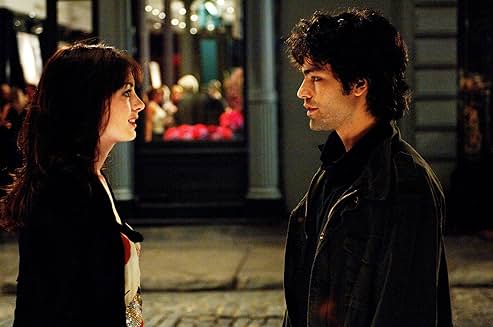
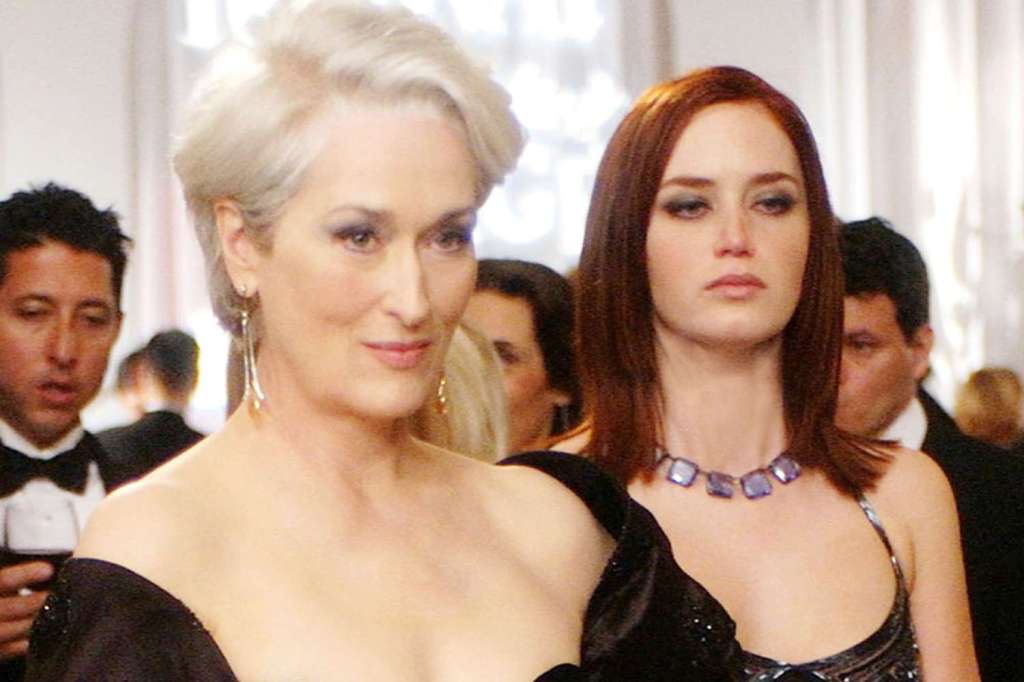
Hathaway isn’t carrying this film alone, though, and she forms a real powerhouse trio with Blunt and Streep. The Devil Wears Prada also shot Emily Blunt to international fame, and it’s clear to see why; she plays the perfect bloodthirsty bitch against Hathaway’s doe-eyed dreamer, leaning on her Englishness to further stand her out against her American colleagues. She works her scenes and the script in a way that actors with twice her experience would yearn to achieve, and also does a surprisingly great job of achieving sympathy amongst the bitchiness in a way that Grenier could’ve learned something from. Emily is also the element outside of the soundtrack (more on that later) that most strongly dates The Devil Wears Prada as a mid-2000’s film, with aggressive combinations of colour and style across hair and make-up that screams both haute couture and Claire’s Accessories in the same rainbow-sparkled voice.
I haven’t read other reviews of this film but I’m willing to bet most other reviewers didn’t take this long to talk about Miranda Priestly. Unlike Hathaway and Blunt, Meryl Streep was already an iconic presence in Hollywood, and The Devil Wears Prada certainly doesn’t hurt her status in any way. Priestly is sharp, witty and devastatingly quick with comments and insults, and is happy to levy them at anyone who catches her eye in the wrong way; creating a character who really represents what most people would imagine when thinking about a taste-maker in fashion. Priestly is an apex predator in the fashion world and Streep plays her perfectly, demonstrating why she developed her reputation as a comedic and dramatic screen legend. Despite the fact that Priestly operates as the de facto villain of The Devil Wears Prada, Streep is still able to bring a sympathetic side to her that avoids her descending into a Cruella De Ville-esque villain, humanising her in a way that garners sympathy but doesn’t excuse her of how she treats the people around her, even in her own darkest moments.
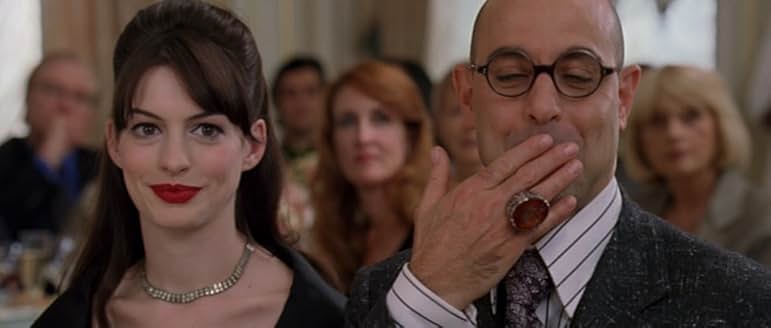
If we’re talking about acting and acerbic wit, it would be remiss not to mention Stanley Tucci (The Terminal) as Nigel, Priestly’s long-serving Art Director and the closest thing we see to a true friend. He walks that line incredibly well, but also takes to Andy and becomes a quiet ally for her in the office. Tucci’s charisma and wit shine through amongst an appropriate helping of camp for the role he’s playing (a level of camp that would lead to a whole generation not realising he’s straight in real life), and his presence on screen is a joy in every scene. Nigel’s relationship with Priestly feels realistic for the environment that it has grown in, and Tucci does a great job of balancing that friendship with Nigel’s fondness for Andy, never really jeopardising his position to help her.
I mentioned the soundtrack earlier, and some of the tracks aren’t a surprise; a film about a fashion magazine without Madonna’s Vogue at a key moment would be a catastrophic mistake. However, the stand out track for me is Suddenly I See by K.T. Tunstall, which is both a touchstone of the 2000’s music scene but also another career fundamentally made by association with this film, as Tunstall’s popularity and longevity are not in any doubt 20 years on, and a place on this soundtrack helped Tunstall with her international recognition. Every song on this soundtrack delivers, which is good; as The Devil Wears Prada has a healthy appreciation for a montage and a crash zoom set to some iconic chart hits; another hallmark of its era which is not unwelcome by any stretch of the imagination. The cinematography supports and highlights the film’s reverence and appreciation of the fashion world, with fast movement and bright colours pairing together for a kaleidoscope of activity which works beautifully whether it’s at the forefront of the action, or quietly working away in the background behind the central cast as they do their thing.
20 years on, The Devil Wears Prada holds up surprisingly well, despite being a snapshot of mid-2000’s culture and filmmaking. The narrative carefully balances reverence for the fashion world with satire for the unrelenting grind and pace of the industry, and hosts a set of performances that both made and cemented multiple careers. With a legacy sequel in theatres now, whether you’re revisiting The Devil Wears Prada or planning to watch it for the first time like I did, this is absolutely a film that is worth watching.
 Dave Writes Reviews