

The power of sacrifice is in the cost of the person making it.
Christopher Nolan is certainly no stranger to ambitious filmmaking. We have seen throughout his whole career, including the award-winning Oppenheimer, reality bending outings like Interstellar and Tenet, and even his take on Batman with The Dark Knight Trilogy. His drive and ambition have led him here; an epic adaptation of Homer’s classic poem The Odyssey; the story of Odysseus, King of Ithaca, as he tries to find his way home after 10 years away laying siege to Troy.
Shot entirely in IMAX 70mm, Nolan had a clear intent for The Odyssey – make a film as bold, as huge, as breathtaking as the original poem. In that regard, I believe he succeeded; The Odyssey is an incredible epic of cinema, with sweeping vistas, beautiful environments and giant characters, some literally, that defy belief but are played out before our very eyes. Nolan’s use of practical effects makes this all the more impressive; by now, the story is well known that one of Matt Damon’s stunt double was a 4”5 woman named Devyn Dalton, who stood before 7” actors playing the Laestrygonians. Polyphemus, the one-eyed son of Poseidon better known as the Cyclops,is a 60” monster brought to life through a mix of CGI, the live action work of Bill Irwin, and a giant, wooden puppet. The beauty, the majesty and the technical prowess of Nolan as a director and the team he works with is on full display from start to finish of this film and is hard to be ignored. Combined with the bold, brash soundtrack by Ludwig Goransson and the cinematography from Hoyte Van Hoytema, The Odyssey is a cinematic feast for the eyes and the ears and is truly a triumph of modern film-making.
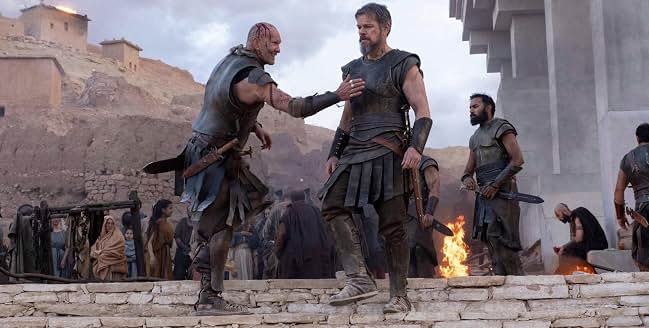
However, a film does not live and die on its practicalities alone, and a 3 hour epic needs an engaging narrative and talented actors to keep an audience engaged. The latter has never been much of an issue for Nolan, and the huge ensemble cast is firing on all cylinders for this film. Matt Damon takes the lead as the titular Odysseus and shows us his quiet, competent leadership throughout this huge tale. Strength and stoicism shine through, but there is also a vulnerability and uncertainty in all the right moments that makes this one of Damon’s finest performances in his career. Alongside him for much of the film is Himesh Patel as Eurylochus, Odysseus’ second-in-command and a man who is most likely to stand opposed to his commander. His presence is vital for shaping the response to some of Odysseus’ decisions, providing a conduit to how his men are feeling to his sometimes chaotic decisions; and his physical acting is exceptional in all the right moments.
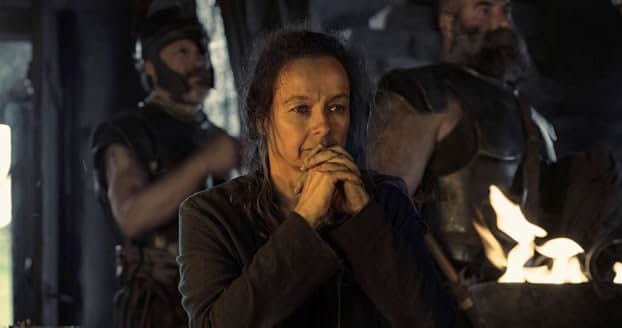
There’s a huge cast and it would take forever to discuss everyone; Anne Hathaway and Tom Holland both shine as Penelope and Telemicus respectively, with Holland’s eternal youth and boyish charms buying him one more outing as a character a decade below his actual age, though that presumably can’t last much longer. Hathaway is tremendous in this film, portraying a complicated blend of rage and abject sorrow simultaneously with such passion that it cannot be ignored. A practically unrecognizable John Leguizamo shines with limited screen time as Eumaeus, a dedicated servant to Odysseus; and brief but powerful performances from the likes of Lupita Nyong’o, Benny Safdie, Zendaya, Elliot Page, Charlize Theron, Jon Bernthal and so many more talented actors who help flesh out this world and bring life to it. One more person who should be properly noted is Samantha Morton, who plays Circe, in one of the scenes which has stayed most clearly with me in the time since seeing The Odyssey; a performance that brings depth and realism to one of the film’s most fantastical moments, but also reveals one of its most fatal flaws.
I have praised Nolan for his film-making, and his direction, but I have not yet mentioned the narrative; and while it certainly is not bad, there are choices made that I feel hurt the film overall. All of these choices, perhaps ironically, lie within Nolan’s obsession with realism. This is something we have seen before, with the most resonant critiques of The Dark Knight Trilogy revolving around how Nolan stripped away the more fantastical comic book parts of each character to place his Batman within a realistic, functioning world. The same can be said for The Odyssey; in an epic tale of gods and monsters, the influence of the gods in particular has been largely stripped out of the text and placed the deities in the background, with Odysseus’ personal flaws being held up as the cause of mistakes on their journey home that lead to their woes, rather than his arrogance resulting in friction with the gods and leading to their intervention. It creates an odd juxtaposition with the text, as Odysseus and his crew travel to Hades to speak with the dead, or encounter the witchcraft of Circe. Even Athena, who stands by Odysseus’ side through the journey, is almost treated like the hallucinations of a desperate man over the steady hand of a guardian deity. There are also some landmark sequences which the film seems to blast through as quickly as possible, perhaps because Nolan did not see a valuable opportunity for character development within them, but one in particular (which I won’t mention plainly to avoid spoilers) seemed to me like it could’ve been afforded more time to allow for greater impact.
This narrative shift is not the only change, but it is the most jarring to the narrative. Most of the other changes that I could identify (as it’s been a long time since I’ve read The Odyssey in any form) serve to make Odysseus a more palatable figure in the audience’s eyes; the reduction of his arrogance being a key driver in that endeavour. It’s not necessarily a bad thing at every point, and Nolan is clearly using his shifts to comment on the moral burden and guilt of war and survival, but it comes at the potential cost of narrative coherence at various points. He has created an Odysseus that the audience can root for, and that’s not a bad thing within the context of this film; but the removal of that character trait shifts the perception of Odysseus and his crew in some sequences that null their original intent from the poem. That serves Nolan well here, but grinds a gear within the overall story.
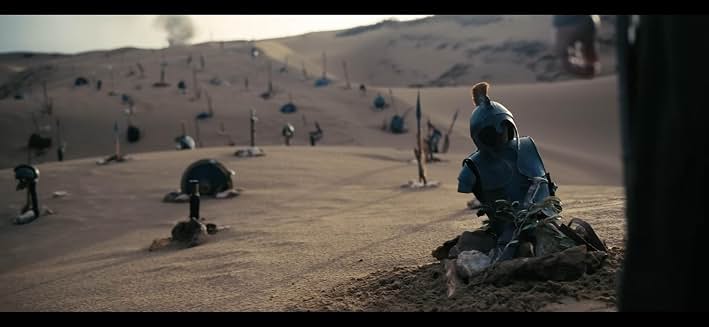
That being said, when the narrative does work, it really works. The recounting of the siege of Troy in particular is expertly done, with narrative, direction and acting all coming together beautifully. Nolan cramming around 20 actors into an actual wooden horse is a sight to be seen and another one of the highlights of this film; as is the tenderness and care taken when Odysseus does finally make it back to Ithaca and everything that happens from that point. Again, spoiler free, but the shifts that Nolan makes here work to the benefit of the whole piece and form an excellent closing sequence both for Odysseus and for Matt Damon. There was a moment in the final act that brought me to tears in the cinema, and that’s not something that happens often.
This is a beautiful and ambitious piece of filmmaking that will be remembered throughout history for all of the right reasons, likely overcoming its flaws in the overall memory of cinema. A triumph of practical filmmaking, of cinematography and a well-acted epic that will undoubtedly receive boundless nominations and likely more than a few wins; you would be cheating yourself if you consider yourself a fan of cinema and don’t attempt to see this either in IMAX or on 70mm; both, if you can make that happen.
I’m begging for an interval, though.

